The Serviceberry
While these native species are most diverse in the northern United States and Canada, it can be found in all states (except Hawaii). Similar to blueberries, this deciduous tree or shrub of the rose family grows just about anywhere. There are several different species, about 20, known by several different common names.
Some of the more familiar species:
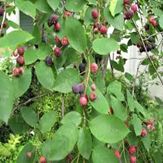
Amelanchier arborea- Downy Serviceberry. Other common names include Indian cherry, juneberry, sarvisberry, shadblow, shadwood, sugarplum and wild-plum
One of the first woodland species to bloom, small racemes of white, rarely pink or yellow flowers appear in early spring. The small 1-1.5 cm, fruits range in color from purplish red to purplish black, darkening when closer to maturity in June through July. The juicy berries have a sweet flavor, and are also high in iron and copper. In some areas, the berries are harvested to make jams and pies. They can be eaten raw or in desserts. Historically, native peoples used them in soups, stews and pemmican. They were also used in medicines for stomach and liver problems, and the juice was used as a dye.
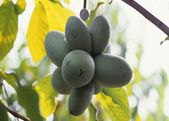
The Pawpaw
There’s a secret snack around. Kayakers who paddle the waters near Washington, D.C., tell about a mango-like fruit that grows along the banks of the Potomac, in Virginia and North and South Carolina — a speckled and homely skin that hides a tasty treat. A tropical-like fruit here, it's the only temperate member of a tropical family of trees. You couldn't buy the pawpaw in stores, so for years, the only way to eat them was straight from the tree.
"Wow," was the first word out of the mouth of one hiker when he tasted one he found the mango-meets-the-banana berry... with a little hint of melon. Although you may not have heard of it, the pawpaw has quite a history. Thomas Jefferson had pawpaws at Monticello. Lewis and Clark wrote in their journals that they were quite fond of the pawpaw. At one point during their expedition in 1806, they relied on paw paws when other provisions ran low. And people have even named towns and lakes after the pawpaw.
But the pawpaw has only recently been commercialized. That's one reason you don't see it in the grocery store. So far, there are just a few orchards selling to farmers markets. Plant scientist Neal Peterson has spent the past 35 years breeding the pawpaw to make it look and taste more like a fruit we'd buy. He has selected and grown varieties that are bigger, with more flesh. After tasting his first wild pawpaw 35 years ago, he had an ”Eureka” moment. Peterson thought that the pawpaw was every bit the rival of a perfect peach or apple — fruits that have had thousands of years of breeding.
Why hadn't someone done this with the pawpaw? "I could just instantly make that leap of imagination," he says.
Some three decades later, he has a lot to show for it. His pawpaws are being grown in a few orchards and sold at farmers markets. And now it's moving beyond novelty. A food scientist at Ohio University, Rob Brannan, is interested in studying the nutrients in the pawpaw. So far, he has published one study that found the antioxidant count in the fruit to be pretty high. "It's about the same as a cranberry" or a cherry, Brannan says. You can even make pawpaw beer and pawpaw sorbet or ice cream?????.........
If scientists could put a "health halo" over the pawpaw, Brannan says, it would give the fruit a commercial boost. It's happened before. Pomegranate juice, anyone?
"Yum — wonderful flavor," Joan Foster said after tasting her first pawpaw at the Olney Farm Market recently. She has been waiting a long time to try one. They're only available a few weeks out of the year — and this year's pawpaw season is just about over.
Mr. Bill says, "Hooray for the Pawpaw and Serviceberry!!!"
More to think about, as we strive to find better tasting and innovative ideas for ice cream; going to go out on a limb and say you never thought about what I am going to reveal to you. If you did, you gotta let me know. Well, here goes...
Figs
Although dried figs are available throughout the year, there is nothing like the unique taste and texture of fresh figs. They are lusciously sweet with a texture that combines the chewiness of their flesh, the smoothness of their skin, and the crunchiness of their seeds. California figs are available from June through September; some European varieties are available through autumn.
Figs can trace their history back to the earliest of times with mentions in the Bible and other ancient writings. They are thought to have been first cultivated in Egypt. They spread to ancient Crete and then subsequently, around the 9th century BC, to ancient Greece, where they became a staple foodstuff in the traditional diet. Figs were held in such esteem by the Greeks that they created laws forbidding the export of the best quality figs. Figs were also revered in ancient Rome where they were thought of as a sacred fruit. According to Roman myth, the wolf that nurtured the twin founders of Rome, Romulus and Remus, rested under a fig tree. During this period of history, at least 29 varieties of figs were already known.
Figs were later introduced to other regions of the Mediterranean by ancient conquerors and then brought to the Western Hemisphere by the Spaniards in the early 16th century. In the late 19th century, when Spanish missionaries established the mission in San Diego, California, they also planted fig trees. These figs turned out to be inferior in quality to those that were imported from Europe, and it wasn't until the development of further cultivation techniques in the early 20th century that California began focused cultivation and processing of figs. Today, California remains one of the largest producers of figs in addition to Turkey, Greece, Portugal and Spain.
Figs grow on the Ficus tree (Ficus carica), which is a member of the Mulberry family. They are unique in that they have an opening, called the "ostiole" or "eye," which is not connected to the tree, but which helps the fruit's development by increasing its communication with the environment. Figs range dramatically in color and subtly in texture depending upon the variety. The majority of figs are dried, either by exposure to sunlight or through an artificial process, creating a sweet and nutritious dried fruit that can be enjoyed throughout the year.
Figs help lower your High Blood Pressure because figs are a good source of potassium, a mineral that helps to control blood pressure. Since many people not only do not eat enough fruits and vegetables, but do consume high amounts of sodium as salt is frequently added to processed foods, they may be deficient in potassium. Low intake of potassium-rich foods, especially when coupled with a high intake of sodium, can lead to hypertension.
Figs are a good source of dietary fiber. Fiber and fiber-rich foods may have a positive effect on weight management. In one study, women who increased their fiber intake with supplements significantly decreased their energy intake, yet their hunger and satiety scores did not change. Figs, like other high fiber foods, may be helpful in a weight management program.
You probably do not think about the leaves of the fig tree as one of fig's edible parts. But in some cultures, fig leaves are a common part of the menu, and for good reason. The leaves of the fig have repeatedly been shown to have antidiabetic properties and can actually reduce the amount of insulin needed by persons with diabetes who require insulin injections. In one study, a liquid extract made from fig leaves was simply added to the breakfast of insulin-dependent diabetic subjects in order to produce this insulin-lowering effect.
Fig leaves have been shown to lower levels of triglycerides (a form in which fats circulate in the bloodstream), while in in vitro studies, fig leaves inhibited the growth of certain types of cancer cells. Researchers have not yet determined exactly which substances in fig leaves are responsible for these remarkable healing effects. Besides their potassium and fiber content, figs emerged from our food ranking system as a good source of the trace mineral manganese.
Vitamins and carotenoids were not strongly related to incidence of a form MD, fruit (figs)intake can definitely protect against the severe form of this vision-destroying disease. Three servings of fruit may sound like a lot to eat each day, but eating a small dose of figs, you can reach a level of protection.
Figs are a culinary delicacy par excellence. Part of the wonder of the fig comes from its unique taste and texture. Figs are lusciously sweet and feature a complex texture that combines the chewiness of their flesh, the smoothness of their skin, and the crunchiness of their seeds. In addition, since fresh figs are so delicate and perishable, some of their mystique comes from their relative rarity. Because of this, the majority of figs are dried, either by exposure to sunlight or through an artificial process, creating a sweet and nutritious dried fruit that can be enjoyed throughout the year. Figs grow on the Ficus tree (Ficus carica), which is a member of the Mulberry family. They are unique in that they have an opening, called the "ostiole" or "eye," which is not connected to the tree, but which helps the fruit's development, aiding it in communication with the environment.
What if, someone decided to use figs to sweeten ice cream??? Wouldn’t that be a novel idea?
Read on.........
How it all began…
There is a “new” milk out now. This “new” milk was found in New Zealand in 2000 by a scientist who worked on a very significant and amazing discovery: cows naturally produce different types of milk proteins and these proteins affect people differently.
There are commonly many types of proteins naturally found in milk. Beta-casein protein is one type that accounts for about a third of the total milk protein. All cows make beta-casein protein. However, it’s the type of beta-casein that we believe makes all the difference for many.
A2 beta –casein protein is recognized as being the original beta-casein protein in cows. That is, originally all domesticated cows produced milk containing only the A2 protein.
However, owing to a natural genetic mutation, another milk protein (A1 beta-casein protein) appeared in Europe and spread throughout global herds via modern farming practices.
Research has shown that A1 and A2 proteins digest differently. Current and growing scientific evidence supports that the different protein fragments produced have an impact on aspects of digestive function, and subsequent down-stream facets of human health. The science is still catching up to what many healthcare professionals and consumers have been saying for years.
It all starts with hand-picking the right cows. A2 Milk™ is a 100% natural fresh cows’ milk from specially selected cows, not a product of genetic engineering or a technological process.
They worked with farmers to identify and select cows that naturally produce milk containing only the A2 protein, and is free from all A1 protein. These cows are certified to produce milk with only the A2 protein and are segregated and milked separately to produce completely natural a2 Milk™ that’s full of nutritional goodness. Cows certified to produce only the A2 protein make exceptional milk, and ensure the greatest quality and freshest tasting milk is delivered.
Many consumers and health care professionals report that, when people experience discomfort drinking ordinary cows’ milk, they may experience relief when they switch to a2 Milk™.
Essentially, the natural difference in protein structure between a2 Milk™ and all other ordinary cows’ milk can lead to a difference in digestive breakdown. There is a deep and growing body of scientific evidence that supports the unique benefits of a2 Milk™. To date, over 100 independent studies have been published that support the A2 protein hypotheses.
Here is one extract that mirrors what health care professionals and academics from around the world have to say:
“In my experience, many people who don’t have classic allergic reactions to cows’ milk protein nonetheless react badly to ordinary A1 cows’ milk (and products made from this), but can happily consume A2 milk without experiencing any of the same problems. Sensitivity to the opioid peptide BCM-7, which is produced from A1 but not A2 milk, could help to explain why this is so. We know a2 Milk™ helps many people all over the world enjoy the benefits of pure and natural milk again. They say it just feels better in their bodies. We like to think we’re bringing the pleasure of real and natural milk, for many people, every day."
Mr Bill’s Ice Cream City is in the process of asking our producer to change to A2 milk. We will keep you posted.
Question: Why do some brands of ice cream cost so much more?
Have you ever wondered why a pint of “premium” ice cream brands cost the same as a half gallon (or more) of a store brand or other inexpensive brand? Even if you can taste the difference between two brands, it may be tough to point to exactly what causes the price difference. There are several key reasons that an ice cream may be more expensive, such as air content, butterfat, and the quality of the ingredients.
Answer:
Air Content
When ice cream is churned, the process whips air into the mixture. Air is incredibly important in giving ice cream the texture we know and love. However, premium ice cream has much less air than most inexpensive brands. This makes the texture denser and richer. This is one of the reasons why gelato has such a different texture than ice cream.
Those cheap ice cream brands are often lighter and fluffier, because they have more air whipped into them. Think about that for a moment. Air is free, which means that part of the reasons the cheap brands are cheap is because they have less cream and sugar than the same volume of a pricier ice cream will.
Butterfat
In order to be called ice cream in the United States, a product must contain at least 10% butterfat. Some of the premium ice cream brands actually contain even more than this, in the 13 to 17% range. Although a product with less fat might be easier on your waistline, the fat content gives the product a creamier texture.
Many inexpensive brands may not include the words “ice cream” anywhere on the label because they don’t meet the requirements for fat content.
Next time you are at the store, check out some of the big brands that come in half-gallon containers and see how many of them actually include the word “ice cream” on the label. You may be surprised!
Premium Ingredients
Have you ever read the label on a premium brand of chocolate chip ice cream and then on a low-price brand?
If you check out the labels, you may notice the ingredient of “chocolaty chips” in some of the cheaper products. As you can imagine, “chocolaty chips” don’t meet the standards to be called chocolate by law. Higher quality chunks of chocolate are going to be more expensive for the company to procure than chocolaty chips that are often made with vegetable oils.
High quality brands also tend to use more real fruit and cream, which are often more expensive. Often, you will find more chocolate and mix-ins in these brands. When it comes to ice cream, you really do get what you pay for. While there is a wide range of quality when it comes to inexpensive brands, premium ice cream and local brands are often of a better quality.
Mr Bill's only sells PREMIUM ice cream. Our products contain real chocolate, real nuts, real fruit. Our ice cream is 14% or 16% butterfat., a genuine top tier product......
So. it's your choice.....cheap 10% ice cream if it is that at all and whipped in air or our premium products..........at a slightly higher price, after all, we think quality means something special.........
Mr Bill's Ice Cream, we don't have to say, "Premium" because it ALWAYS is!!!!!